
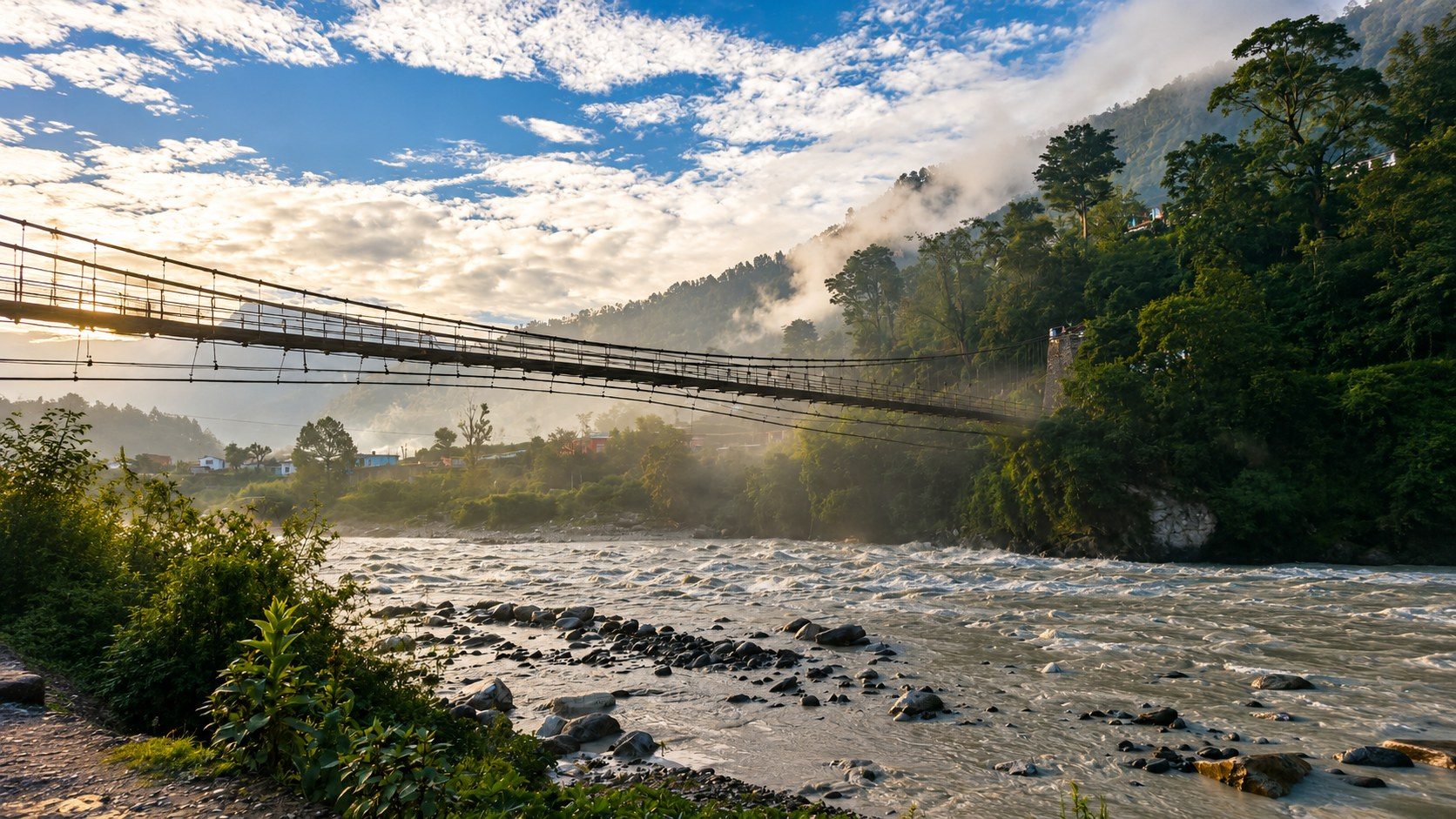
A Place Where Learning Slows Down… and Life Does Too
Long before a teacher training begins, something begins to shift — quieter mornings, mountain air, shared meals, evening conversations.
Our residential campus doesn't just host the programme. It quietly becomes part of the learning itself.

A Slower Place, Chosen on Purpose
We didn't choose Uttarkashi because it was easy to reach. We chose it because it asks something of you before it gives anything back — a slower pace, fewer distractions, and a closeness to nature that has shaped contemplative life here for generations.
The mountains don't make anyone more spiritual. But they remove many of the places where we usually hide from ourselves. Here, the classroom extends beyond four walls — into the garden, the river trail, the quiet of early morning — until nature itself becomes part of how our students learn.
Read our story →More Than a Place to Stay
This is where the days actually happen — where you sleep, practise, study, eat and sit together between sessions. Not a venue you visit for a few hours and leave, but the place your whole stay is built around.

This is Anand Ganga — our residential campus on the banks of the Bhagirathi, and the physical home of everything Stri Wellness teaches. Not a hotel, not a retreat resort — a Gurukul, built around a courtyard, a garden and a river.
Uttarkashi Is Part of the Experience, Too
Ten minutes from our gate, the Bhagirathi runs straight through town — past temples, tea stalls and a rhythm of life that hasn't changed to keep up with anyone. Time here isn't spent only within our walls.

Uttarkashi, where the Bhagirathi valley opens into a small Himalayan town.

Forest trails begin a short walk from where you'll be staying.

Evening aarti on the riverbank — an everyday moment, not a performance.

Where the Day Unfolds
A session might begin in a quiet room and finish on the riverbank. The classroom here isn't fixed to four walls — learning moves between formal instruction, garden practice, quiet observation and unplanned conversation, depending on what the day and the group need.
No two sessions look quite the same. That's by design, not by accident.
A Room of Your Own, by the River
What you'll remember isn't the room number — it's the sound of the Bhagirathi at night, and a veranda you'll return to after every session.


Three Ways to Stay
Choose the setting that feels right for your time with us.
Prithvi
Garden View AccommodationGround-floor accommodation opening towards the garden, offering a quiet and grounded setting for rest.
Akasha
River View AccommodationUpper-floor accommodation with views towards the Bhagirathi valley and surrounding Himalayan landscape.
Ananta
Premium River View AccommodationOur most spacious accommodation category, with additional living space and expansive river and Himalayan views.
Every room includes its own private, attached bathroom — comfort and privacy as part of the standard stay, not an upgrade.
The Shape of an Ordinary Day
This is illustrative only — the exact rhythm varies by programme, season and the day itself.
- 5:45 AM
Sunrise
- 6:30 AM
Morning Practice
- 8:00 AM
Breakfast
- 10:00 AM
Learning Sessions
- 1:00 PM
Lunch
- 3:00 PM
Reading & Reflection
- 5:00 PM
Evening Practice
- 7:00 PM
Dinner
- 9:00 PM
Silence

Simple Food, Shared Together
Meals here are vegetarian and vegan-friendly, seasonal and unfussy — made with ingredients grown close to where we are, and served at the same table where the day's conversations continue.
There is nothing elaborate about how we eat. Mealtimes are simply part of the rhythm — a pause between sessions, a chance to sit together, and one more way the day slows down. Cohorts are small, and meals are eaten together, not because it's required, but because it's usually where the real conversations happen.
Have an allergy or dietary need? Just let us know when you register.

Most evenings end like this — a fire, a few quiet conversations, and nowhere else to be.
A Few Places We'd Point You To
Not a tourist checklist — just the places our own team and students have come to know and return to.
Temples of Uttarkashi
Walks · Temples · Sacred Places
Three temples, each reachable on foot, each with its own rhythm — from a quiet morning walk to a proper forest climb.
- Kashi Vishwanath — the temple the town is named for, a short walk from the centre.
- Kuteti Devi — a climb up Hari Parwat hill, with views back over the valley.
- Shikhareshwar Mahadev — a forest trail up Varuvat mountain via Pata and Sangrali, with a glimpse of Bandarpoonch peak on clear days.
Forest Trails & Hikes
Easy Walks · Day Hikes · Alpine Trails
From a half-day forest walk to a full alpine trek — most trails begin within half an hour of campus.
- Kuflon — an easy pine and rhododendron walk, about 20 minutes away, with a small waterfall along the way.
- Khedi Waterfall — a short roadside stop on the way to Maneri.
- Dayara Bugyal — alpine meadows reachable from Raithal village with an early start.
- Dodital (first stretch) — an easier, forested taste of the longer trail from Sangam Chatti.
Gangotri
Roughly 100 km further up the same Himalayan highway — a longer day trip, not a casual outing, but a meaningful one if your dates allow it.
Local Markets
Small, unhurried, and genuinely local. Good for fruit, everyday essentials and a sense of how the town actually lives day to day.
Small Villages
The villages scattered along the Bhagirathi offer a quieter, slower version of Himalayan life worth seeing at least once during a longer stay.
Good to Know Before You Arrive
Short answers here — for the full detail, our Practical Guide covers travel, packing and logistics in depth.
How do we travel to the campus?
What is the weather like in Uttarkashi?
What should we pack?
Is internet available on campus?
Is laundry available?
Should we be concerned about altitude?
What if someone needs medical care?
How do we get around locally?
Is Our Himalayan Home a hotel we can book directly?
How is this different from a programme page?
Come Experience It Yourself
Photographs can only carry you so far. The rest — the quiet, the air, the pace of the day — is something you feel once you're here.